

Do Geography and Environment Shape Racial Bias? A Large-Scale Multilevel Test
Contextual theories of racial bias, linking economic conditions, disease environments, and demographic composition to individual attitudes, are widely cited but rarely subjected to rigorous methodological scrutiny. Analysing over 3 million Project Implicit respondents, this project finds that geography explains remarkably little: contextual predictors account for under 2% of individual variance in racial bias, and 87.5% of initially significant associations fail False Discovery Rate correction.
Despite many human advances, discrimination of protected characteristics remains an all too frequent issue in society. A substantial literature claims that contextual factors, economic conditions, demographic composition, historical institutions, infectious disease environments, shape individual racial attitudes and bias. Yet these contextual claims typically rest on weak empirical foundations: studies analyse predictors at the state level, test single hypotheses in isolation, rarely correct for multiple comparisons, and neglect interpreting effect sizes.
This project rigorously tests five leading contextual hypotheses simultaneously across multiple spatial scales (individual, county, state), measurement modalities (implicit and explicit attitudes), and racial groups. It applies False Discovery Rate corrections across all tests, quantifying the false positive inflation that may characterise prior literature, and interprets effect sizes within a systematic framework enabling clear comparison across predictors and outcomes.
The US analyses draw on Project Implicit Race IAT data from over 3 million respondents (2006–2019) across approximately 3,000 US counties and all 50 states, supplemented by the American National Election Studies (n > 80,000), Google Trends search data, and Twitter/X sentiment data. Five contextual hypotheses are tested: parasite-stress theory (infectious disease prevalence), realistic conflict theory (unemployment), social dominance theory (income inequality / Gini coefficient), historical institutionalism (Confederate state status), and intergroup contact / demographic threat (race exposure).
Cross-scale multilevel models simultaneously estimate county- and state-level contextual effects while outcomes (implicit D-scores, explicit attitudes, feeling thermometers, Bayesian Racism Scale) remain at the individual level: directly addressing the modifiable areal unit problem. The Benjamini–Yekutieli False Discovery Rate procedure (q = 0.05) is applied as a single omnibus correction across all 128 tests (16 contextual predictors × 4 outcomes × 2 racial groups × 2 spatial levels), providing valid FDR control under arbitrary dependence structures.
Contextual predictors explain minimal variance in racial bias. State-level clustering accounted for less than 0.3% of variance across all outcomes; county-level clustering explained at most 1.8%. Even combining all contextual predictors with individual covariates, models explained less than 8.2% of total variance — with over 90% residing at the individual level.
Across 128 tests, only 16 (12.5%) survived FDR correction, all at the county level. No state-level predictor reached significance after correction, suggesting that prior state-level findings in this literature may largely reflect spatial aggregation artefacts rather than genuine contextual effects. Key findings by predictor:
- Race exposure produced the most robust associations (7 of 16 FDR-significant effects). Patterns diverged asymmetrically by group: greater Black population exposure predicted stronger pro-White bias among White participants (consistent with group threat theory), while greater White exposure predicted stronger pro-White bias among Black participants (consistent with contact theory for minority group members).
- Disease prevalence and unemployment each yielded 2 FDR-significant effects with limited and inconsistent directionality; stronger effects in aggregated analyses reflect ecological inflation rather than genuine individual-level processes.
- Income inequality produced a single FDR-significant effect for White participants’ explicit attitudes (β = 0.010).
- Confederate state status showed no FDR-significant associations across any outcome or racial group.
Among individual-level predictors, political ideology dominated explanatory power: for White participants, it accounted for 65–75% of the variance explained across outcomes: more than all contextual predictors combined by orders of magnitude. These results suggest that effective interventions must primarily target individual-level processes, with geographic approaches serving as complements rather than substitutes.
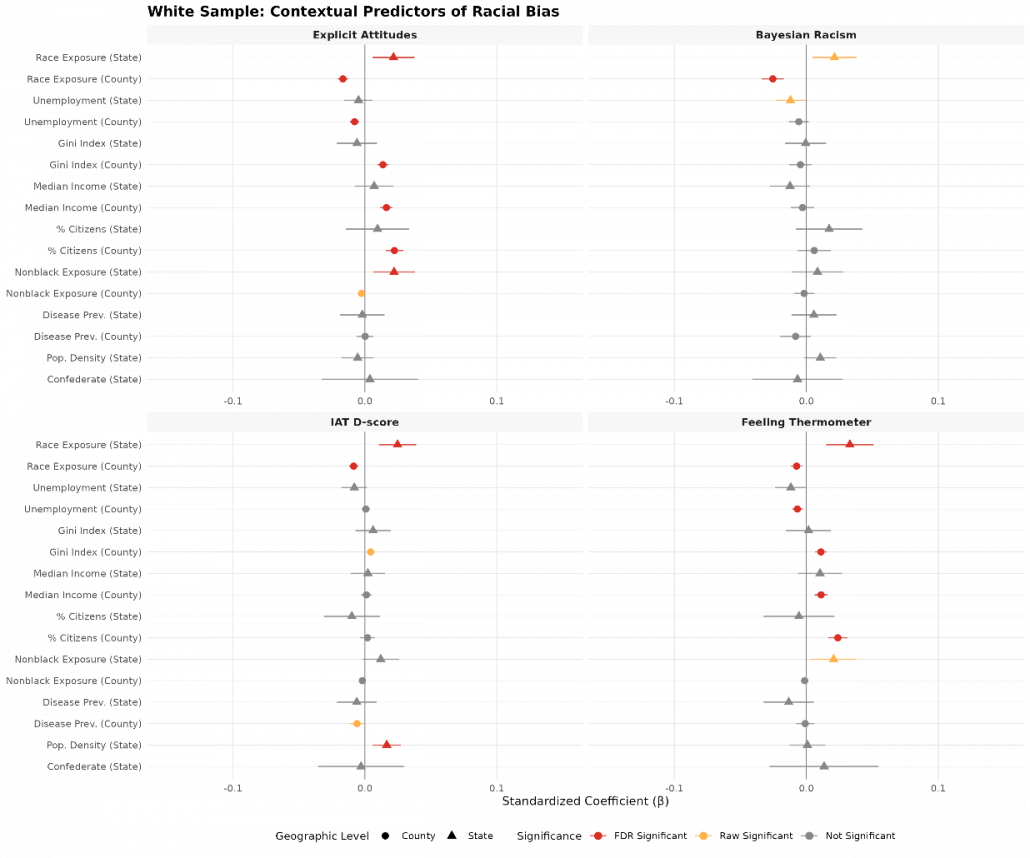
Figure 1: Standardised coefficients of contextual effects for White participant’s racial bias
Leveraging multiple digital footprint datasets to predict racial, sex-based, and sexual-orientation bias across US states.
Racial, gender, and sexual-orientation biases are pervasive throughout society. Importantly, modern digitally oriented datasets can elucidate important societal variables and potential solutions. One contemporary theory that attempts to explain these biases is … [more]
