

Dimensions underlying public perceptions of food’s environmental impact
To promote dietary shifts among the public, it is crucial to understand how individuals conceptualise the environmental impacts of different food types. A product categorisation study was conducted with UK participants to gain insight into the underlying psychological structure of environmental impact perceptions.
To promote dietary shifts among the public, it is crucial to understand how individuals conceptualise the environmental impacts of different food types. However, prior research has examined perceptions for only a narrow range of product types, using researcher-imposed, single-item environmental friendliness scales, which might not align with consumers’ underlying mental representations. This project utilises a food categorisation task in which UK participants organised a diverse range of supermarket food products into categories that they created and labelled themselves. By analysing the co-occurrence of products within categories and the qualitative labels assigned by participants, we establish insight into the psychological structure of consumers’ environmental impact perceptions.
180 UK participants who reported being the primary grocery shopper in their household took part in the food categorisation task, administered using Useberry online software. Participants were instructed to sort food products into groups according to environmental impact, so that each group consisted of products the participant believed had a similar level of impact. Participants could arrange products into as many or as few categories as they liked.
At the beginning of the task, cards representing the 44 food products were displayed on the left of the screen in random order (Fig 1). Participants created their first category by dragging a card into an empty box in the middle of the screen. They could then add cards to existing categories or create new categories by dragging cards into additional empty boxes. Participants could freely rearrange cards between categories at any time and were required to sort all cards and provide a written label for each category before proceeding.
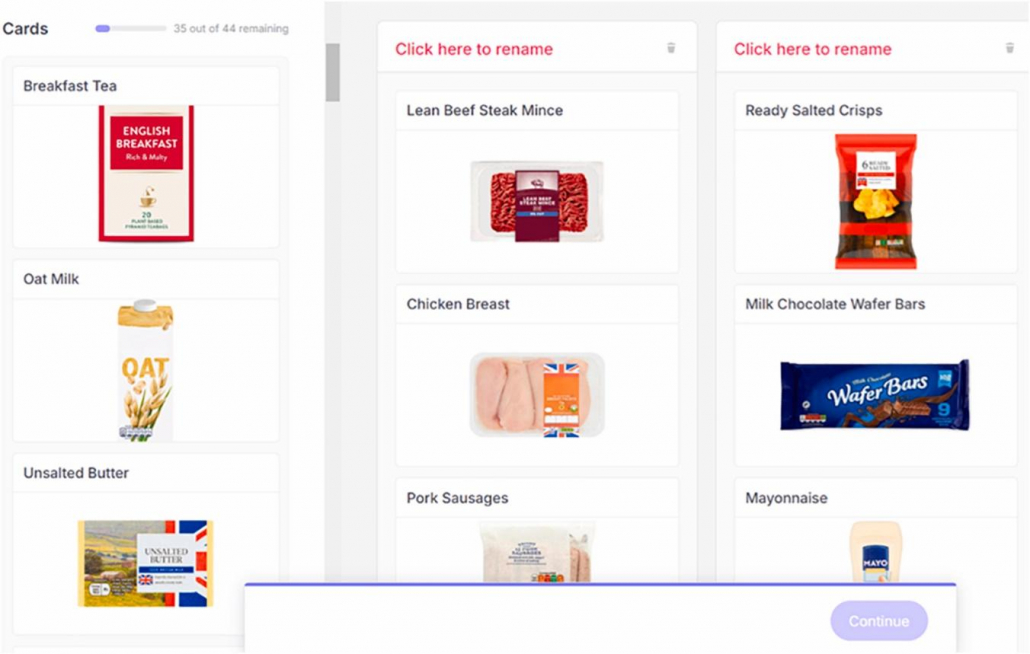
Fig 1: Online card sorting task
The analytical approach entailed word frequency analysis of category labels to examine the types of categories that participants created, and multidimensional scaling (MDS) to explore underlying dimensions in participants’ categorisation behaviour.
To analyse the content of category labels, we split labels (typically a phrase or short sentence) into individual words. We then calculated the number of participants who used each word in at least one of their category labels to identify high-frequency terms; defined as those used by ≥ 10 % of the sample (Fig. 2). “Low”, “high”, “medium” and “impact” were used most frequently, indicating that participants generally followed instructions to categorise foods by level of impact. Other common terms were “process”, and those relating to food type (e.g., “meat”, “dairy”, “vegetable”).
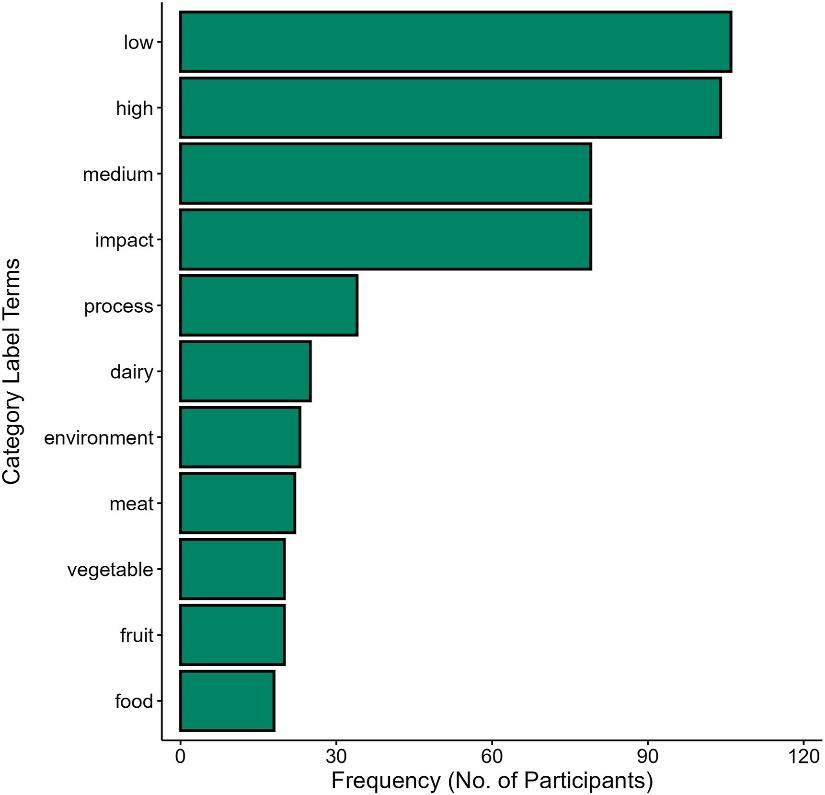
Fig 2: Category label words used by ≥ 10 % of participants
To perform the MDS analysis, a 44 x 44 dissimilarity matrix was first constructed, where individual food products were arranged as row and column headings, and cell values represented the number of participants who did not group each pair of products together. Ordinal MDS was performed on this aggregate dissimilarity matrix to transform the overall pattern of co-occurrences into a lower-dimensional spatial map, where items categorised together more frequently are plotted closer together in the solution.
To aid interpretation of the MDS solution, we analysed associations between products’ MDS coordinates and the category label terms most frequently applied by participants. Associations were examined by regressing category label term frequency measures on to items’ MDS coordinates and overlaying the resulting coefficients as vectors on a biplot. The biplot vectors indicate how strongly regions of the MDS solution are associated with the use of particular category label terms, facilitating interpretation of meaningful directions in the plot.
Based on objective product characteristics, items in the MDS solution appeared to primarily be separated along two dimensions (Fig. 3). An animal versus plant origin dimension was represented approximately by the diagonal from top left (plant-based) to bottom right (animal-based), and a processing dimension was represented by the diagonal from bottom left (low processing) to top right (high processing). This interpretation was supported by a biplot analysis of relevant high frequency category label terms, with “meat”, “dairy” (i.e., animal origin), and “processing” term frequency vectors oriented towards regions of the plot containing products with these characteristics
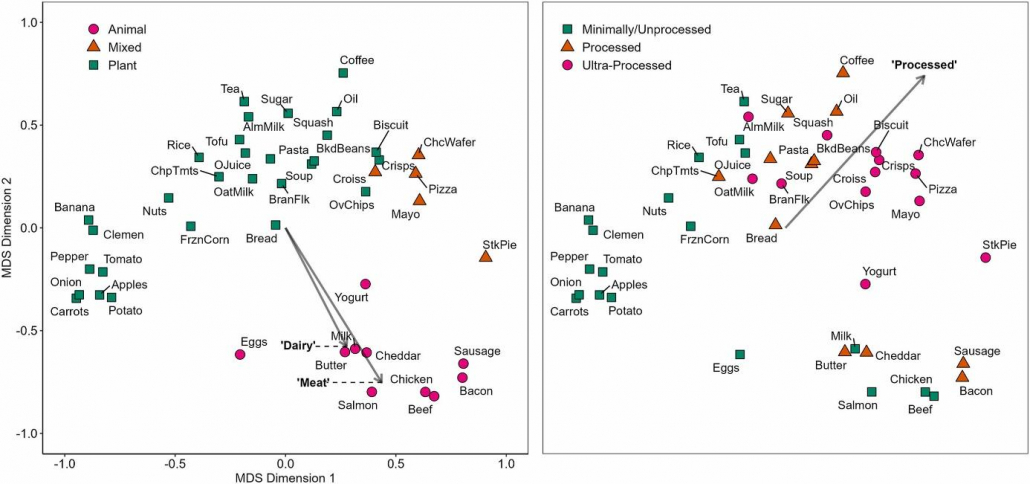
Fig 3: MDS biplot with “meat”, “dairy”, and “processed” category label term frequency vectors
A further biplot analysis of commonly used impact-related category label terms (“low”, “medium”, “high”) indicated that products positioned further to the right of the MDS plot were more often associated with a high environmental impact (Fig. 4). Fresh fruits and vegetables were strongly associated with “low” impact labels; lightly to moderately processed plant-based foods with both “low” and “medium” impact labels; highly processed foods with “medium” and “high” impact labels; and animal origin products (especially meat) with “high” impact labels.
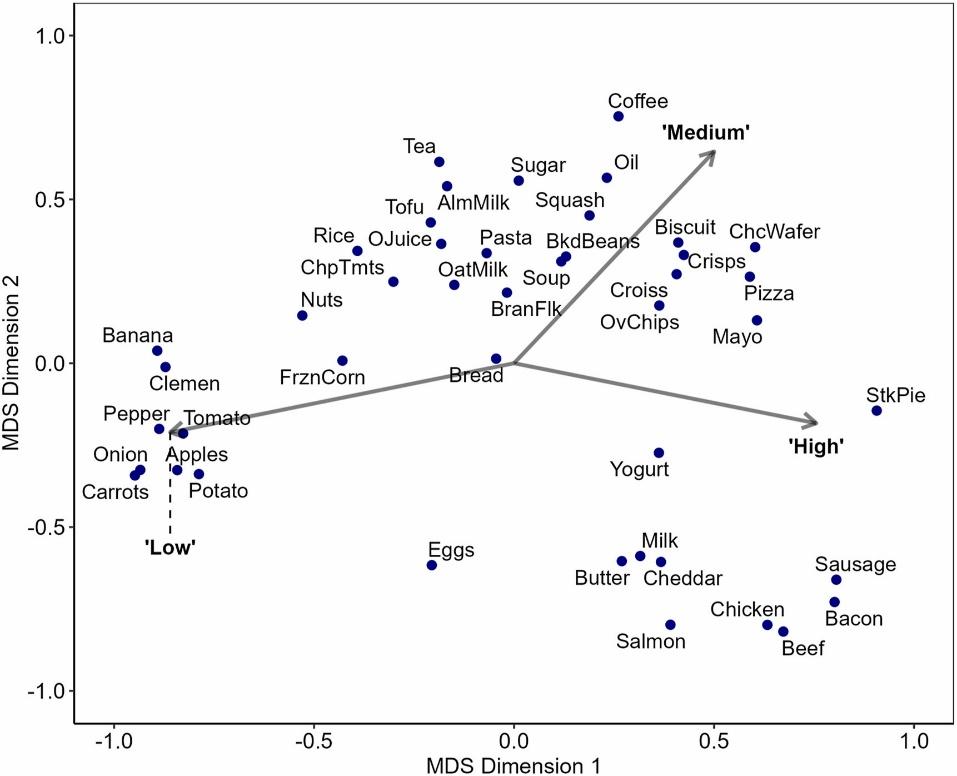
Fig 4: MDS biplot with “low”, “medium”, and “high” category label term frequency vectors
Dimensions underlying public perceptions and misperceptions of food’s environmental impact. Journal of Cleaner Production.
Food systems are a major contributor to environmental impacts such as greenhouse gas emissions and biodiversity loss, with widespread dietary changes required to avoid surpassing safe planetary boundaries by 2050. To promote dietary shifts among the public it is crucial to… [more]

